




One Stop to Waste Less: Income Insurance and Zero Waste SG Launch Singapore’s First Community Circularity Hubs
Eight community circularity hubs, known as Zero Waste Hubs, will make recycling, reuse and refill easier, while using education and community action to build lasting zero-waste habits
15 November 2026
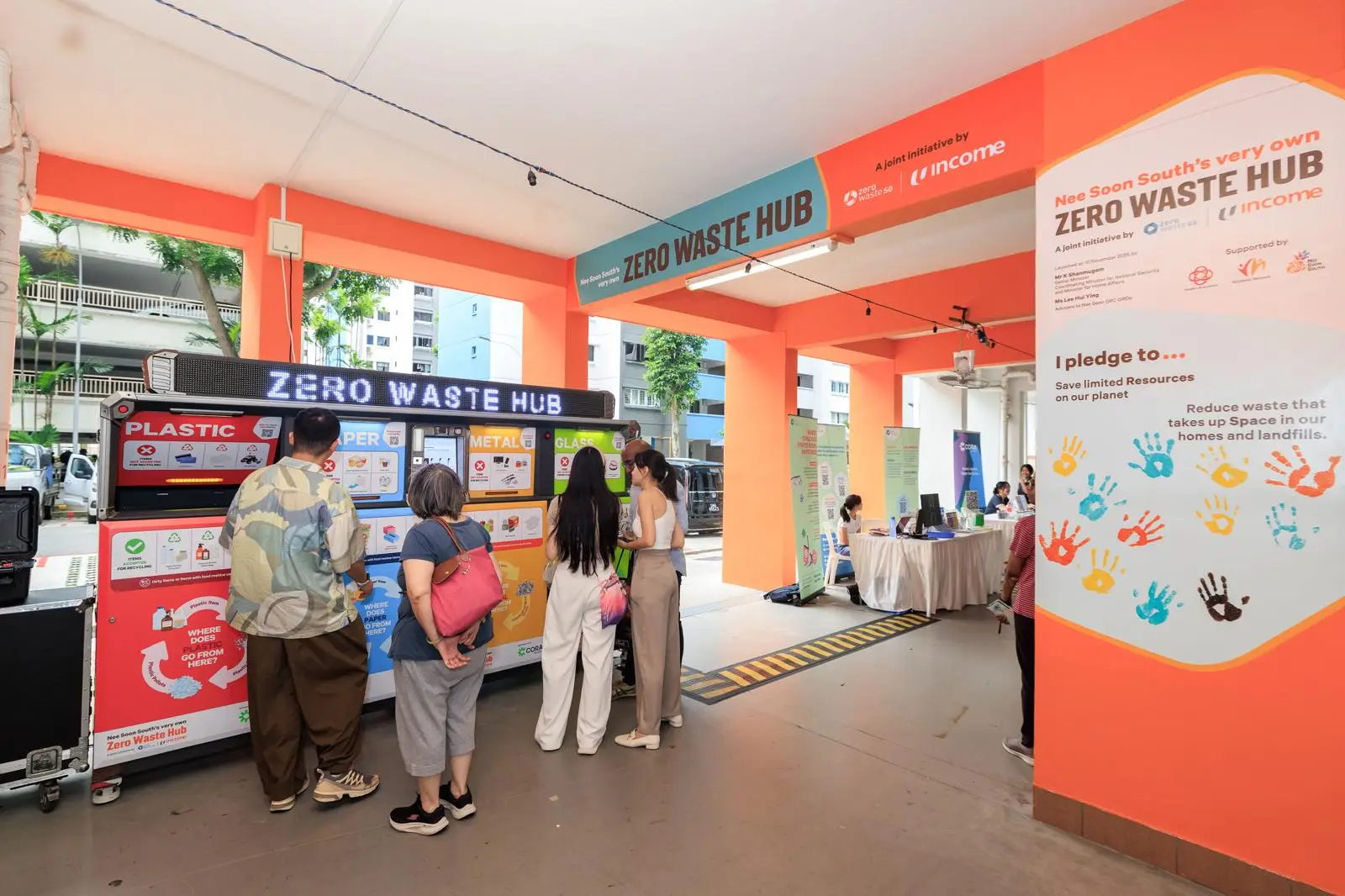
Singapore, 15 November 2026 - Income Insurance Limited (Income Insurance) and non-governmental organisation, Zero Waste SG, today launched the community circularity hubs initiative, Zero Waste Hubs. The first of such Hubs was unveiled at Block 841 Yishun Street 81 in Nee Soon South.
The initiative supports Clean and Green Singapore by bringing recycling, reuse and refill facilities together in one neighbourhood location. It also combines practical education with regular community activities to help residents make waste-conscious choices part of daily life.
Ms Lee Hui Ying, Adviser to Nee Soon GRC Grassroots Organisations (Nee Soon South) and member of the Government Parliamentary Committee for Sustainability and the Environment, attended the launch.
A second Zero Waste Hub will open at Fernvale Community Club in Jalan Kayu by the end of 2026. These are the first two of eight Zero Waste Hubs planned across Singapore by 2028 under a three-year partnership between Income Insurance and Zero Waste SG.
Circularity means keeping products and materials in use for longer so that less waste goes to landfill. At each Zero Waste Hub, residents can refill household detergent using their own containers, donate clean pre-loved clothes, sort paper, plastic, metal and glass for recycling, and deposit e-waste in one trip.
Community action at the core
The Zero Waste Hubs bring together residents, grassroots organisations, non-governmental organisations and businesses. Zero Waste SG leads programme design, delivery and impact measurement. Grassroots organisations support local engagement, while Income Insurance enables the partnerships, infrastructure and sustained outreach needed for the programme to grow.
In Nee Soon South, grassroots organisations will use established community networks to encourage regular participation through outreach and resident-led activities. Residents will be able to learn, volunteer and help their neighbours adopt practical habits. Located near Khatib MRT station, the Hub is designed to make recycling, reuse and refill convenient and accessible.
Ms Lee Hui Ying, Adviser to Nee Soon GRC Grassroots Organisations (Nee Soon South), said, "Climate action starts with our everyday choices, and we need to make those choices easier for every Nee Soon South resident. Together with Zero Waste SG and Income Insurance, we are bringing recycling, reuse and refill facilities closer to home. With this very first Zero Waste Hub, our grassroots organisations will continue working with residents and community partners through regular outreach and activities, turning good intentions into lasting habits. We will work with residents to shape the Zero Waste Hub into a shared and sustainable space that serves the community. This is a starting point to make sustainable choices part of everyday life, together as one Nee Soon South family.”
Andrew Yeo, Chief Executive Officer, Income Insurance, said, “As Singapore reviews its Zero Waste Masterplan, we have an opportunity to help shape a more circular future. Sustainable living should be simple, accessible and part of daily life. We see our efforts in zero-waste advocacy as a progressive continuum. It has extended from raising awareness and supporting reuse pilots to enabling communities to practise circularity and embed such habits in their lifestyle through the Zero Waste Hubs. When small actions become lifestyle habits, they can add up to meaningful collective impact.”
Specialist partners support the Hub at each stage. Cora Environment provides smart recycling stations for paper, plastic, metal and glass. Residents register once to receive a personal QR code, with no app required. This allows Zero Waste SG to track participation and repeat use. Cloop collects clean pre-loved clothes for reuse, Ecoworks runs the household-product refill stations, and ALBA provides e-waste collection bins. The Hub also shares information on the Beverage Container Return Scheme (BCRS).
Targeting the right motivations: Reducing contamination rates at point of recycling from 40% to less than 5%
The Zero Waste Hubs build on Zero Waste SG’s Sort It Out recycling pilots, launched in Queenstown and Pioneer in mid-2025. Singapore’s commingled recycling bins have a reported contamination rate of 40%. By enabling residents to sort materials at source, the pilot stations kept contamination below 5% for paper, plastic, metal and glass at both locations.
By the end of June 2026, the two pilot hubs had recorded 17,314 recycling transactions and collected more than 9.5 tonnes of recyclables. Close to 60% of transactions came from returning users, suggesting that convenient infrastructure and repeated participation can help build habits.
In Queenstown, almost three in five surveyed residents who were willing to recycle said convenience was their main motivation. Clear information on what can be recycled and confidence that their actions matter were the next most important factors. Pioneer showed similar trends.
Lionel Dorai, Executive Director, Zero Waste SG, said, “Our Sort It Out pilots show that residents are consistently willing to sort and recycle more effectively when the infrastructure is convenient, the purpose is clear and they can trust where their recyclables go. The next step is to go beyond recycling alone. Through this partnership with Income Insurance, we can bring reuse, refill and better recycling closer to residents, while gathering the data and insights needed to understand what it takes to make circularity more embedded into everyday living.”
The pilot findings also point to the value of regular, community-led engagement. About half of Queenstown respondents expressed interest in community recycling activities. Participation spanned age groups: residents aged 77 to 86 accounted for the largest share of transactions in Queenstown, while those aged 37 to 46 recorded the largest share in Pioneer. The differences may reflect each area’s demographics, but they show that source-separated recycling can engage varied communities.
These insights shaped the Zero Waste Hubs. Education starts before each Hub opens and continues through door-to-door outreach, talks, volunteer training, community activities and clear on-site guides.
Mr Dorai added, “Our insights show that residents need to know how to take part, understand why it matters and have regular opportunities to practise. By combining practical guidance with community activities, we want recycling right to become something neighbours do together, turning good intentions into everyday habits.”
Building a long-term model for circularity
Income Insurance’s three-year commitment supports the infrastructure, education and community involvement needed to test and improve the model across different neighbourhoods.
During the first year, Zero Waste SG will establish a baseline for each Hub. It will track material recovery, contamination, adoption and repeat use, alongside resident feedback, to understand what helps circular habits take root. The findings will be shared with ecosystem partners and relevant stakeholders to support a model that other constituencies can adopt. Cleaner, better-sorted materials require less handling at sorting facilities. This can lower operating costs and improve the commercial viability of recycling and reuse over time.
The programme complements the National Recycling Programme and supports the Singapore Green Plan 2030 and Zero Waste Masterplan by reducing waste, recovering more resources and diverting materials from landfill.
For more information on Zero Waste SG’s Sort It Out pilot, please refer to its Recommendation Paper: www.zerowastesg.com/publications/siorp


