





Income Insurance and WWF-Singapore Launch Eco Dabao, SG’s First CBD Return-and-Reuse Multi-location Programme for Takeaway Food and Drink Containers
Aims to motivate behavioural change among people working in the CBD by incentivising them to choose reusable containers for takeaway food and drinks at no extra cost, reducing single use packaging waste.
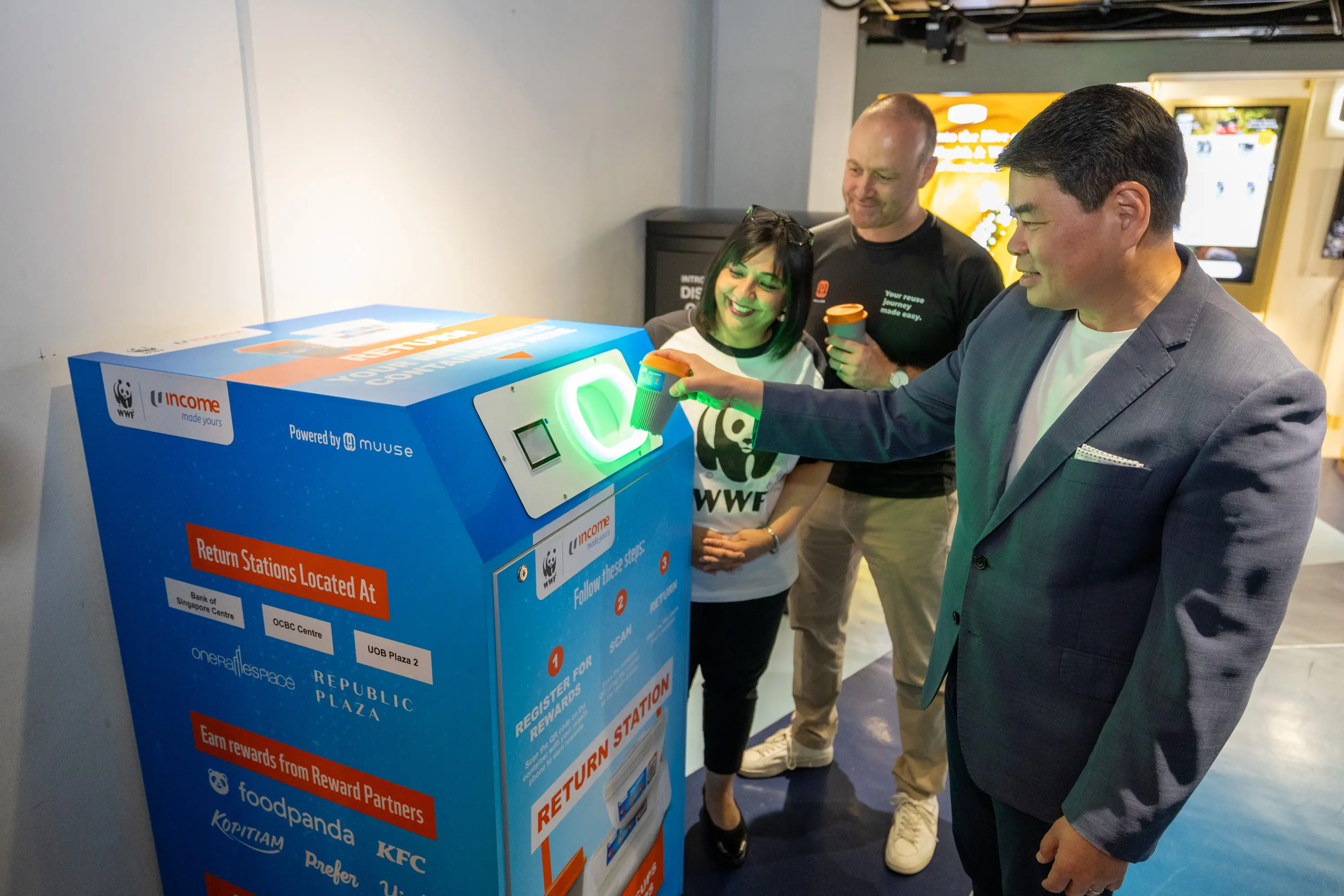
Returning of Eco Dabao containers (from right to left): Andrew Yeo, CEO of Income Insurance, Jonathan Tostevin, CEO and Co-Founder of Muuse, Natasha Raina, General Counsel & Acting Director, Market Transformation, WWF-Singapore
29 April 2026
SINGAPORE, 29 April 2026 – Income Insurance and the World Wide Fund for Nature (WWF) Singapore (WWF-Singapore) today announced the launch of Eco Dabao, Singapore's first return-and-reuse multi-location programme for takeaway food and drink containers in the Central Business District (CBD). It aims to incentivise people working in the CBD through a reward-based system to choose reusable alternatives over single-use disposable food and beverage (F&B) containers as part of their daily routine to enjoy takeaway meals more sustainably.
Taking on an ecosystem approach, the programme powered by reuse partner Muuse, brings together five properties[1] in the CBD and incentive partners[2] respectively, as well as eight participating F&B brands[3] to provide consumers the option for takeaway meals in reusable containers, which they can easily return at one of the five designated collection points after use.
For orders via foodpanda, consumers in the CBD can also opt to have their food and drinks served in the reusable containers and cups when placing orders on the delivery app, applicable only for pick-up order.
The five-month pilot runs from now till September 2026. During this period, Income Insurance, WWF-Singapore and Muuse will gather insights on user behaviour, return patterns and system adoption to refine how the reuse system can be further finessed and implemented more effectively at scale in Singapore. The pilot will also continue scaling its ecosystem partners, with participating F&B vendors looking to increase to 15 locations by July.
With the CBD being one of Singapore’s highest densities of F&B outlets which sees large lunchtime peak loads, the pilot aims to reduce 10,000 single-use packaging over the five-month period. This presents a strong opportunity to reduce packaging waste at scale.
In parallel, Income Insurance has also partnered with Muuse to deploy a workplace-based model to embed the return-and-reuse culture among its employees across its offices. The initiative, which kickstarted on 1 April this year, encourages employees, through gamification, to borrow halal or non-halal reusable food containers from vending machines located within Income Insurance’s offices to pack food from their preferred food stalls, and return the containers after their meals to a dedicated collection points in the offices. In just one month, close to 500 Muuse containers have been borrowed and returned by employees.
“Singapore has made strong progress in building awareness around sustainability, but awareness alone is not enough to drive change,” said Andrew Yeo, Chief Executive Officer of Income Insurance. “The real challenge lies in connecting sustainability to tangible everyday habits that people can understand and act on. With Eco Dabao, we are deepening advocacy for Zero Waste as it helps reframe big environmental issues into small, actional steps, such as avoiding single-use F&B containers, so that people feel they have a role to play in driving change and making a difference. “Reduce, reuse, recycle” is memorable and repeatable. More significantly, small, repeated actions such as participating in Eco Dabao and choosing returnable options for takeaway food and beverages containers form daily habits. By first introducing the return-and-reuse system across our Income Insurance offices and now extending it into the CBD, we aim to normalise the reuse behaviour and to create a ripple effect among more real-economy partners so that we can scale more widely in Singapore, build a sustainable returnable culture and play our part for Zero Waste 2030.”
Sophia Zhu, Chief Operating Officer, WWF-Singapore, highlighted the importance of partnerships in driving meaningful change. “Much of today’s packaging waste is the result of systems designed for single use. Shifting this requires more than incremental fixes - it calls for rethinking how materials are used, reused and kept in circulation. As WWF-Singapore marks our 20th anniversary, initiatives like Eco Dabao reflect a deliberate focus on working with partners to test and scale practical solutions that can shift everyday behaviours. In a dense urban context like the CBD, Eco Dabao demonstrates that reuse can be both viable and convenient when the right systems are in place. What enables this shift is collaboration. When businesses, communities and the public sector align, sustainable choices become easier - and more likely - to be adopted at scale. This is how we move reuse from the margins into the mainstream.”
Bridging the Gap Between Awareness and Action, aligned to Singapore’s vision to go green
Despite sustained public education and strong awareness of sustainability in Singapore, green habits remain inconsistent. A study led by the Ministry of Sustainability and the Environment (MSE) found that key barriers to higher-effort lifestyle changes include reluctance to shift existing consumption patterns, inconvenience, and uncertainty over whether individual actions make a meaningful difference.
In fast-paced urban environments like the CBD, where takeaway meals are a daily norm, convenience continues to shape behaviour and single-use packaging remains the default option for both consumers and businesses. This persistent intention-behaviour gap highlights the need for practical, accessible solutions that enable more sustainable choices at the point of consumption.
Food and packaging waste have also been identified as priority streams under Singapore’s Zero Waste Masterplan because they are generated in large amounts and have low recycling rates. Addressing these waste streams requires upstream interventions that reduce reliance on disposables before they enter the waste system. Eco Dabao aims to avoid more than 10,000 single-use disposables over the five-month pilot, supporting Singapore’s Green Plan target to reduce the amount of waste sent to landfill by 30% by 2030.
How Eco Dabao Works
Eco Dabao addresses this gap through a convenient return-and-reuse system designed to make sustainable choices seamless and accessible. Unlike typical takeaway options that may incur additional charges of 30/50 cents for disposable packaging, Eco Dabao allows users to opt for reusable containers and participating F&B outlets to procure them for free, lowering barriers to adoption across the ecosystem.
Supported by five smart return stations across Raffles Place, conveniently located in high-traffic areas including near MRT stations, the system is designed to make returns convenient as part of users’ daily routines.
Designed to minimise user effort with no washing of containers and cups required, users simply:
- Borrow a reusable food or drink container from a participating F&B outlet
- Scan the unique QR code on the container to register and unlock rewards for redemption
- After use, return the reusable containers at any designated collection point
An incentive programme, supported by participating brands such as Kopitiam and KFC through discounts and vouchers, encourages trial and repeat usage, reinforcing behaviour change over time. By making reuse visible and rewarding, Eco Dabao is designed not just as a pilot, but as a habit-building solution that supports sustained adoption.
Strengthening Collective Action for a Zero-Waste Future
Eco Dabao builds on Income Insurance’s ongoing efforts to drive zero-waste. Through its annual Income Eco Run (IER), Income Insurance rallies individuals and communities across Singapore behind a sustainable lifestyle through the run and public education initiatives. For every kilometre clocked at the IER, Income Insurance pledges a dollar towards a green cause. Funds raised through IER 2025 have enabled the launch of Eco Dabao in the CBD, translating collective action into a practical, real-world solution.
Echoing the IER theme, “How far will you go for Zero Waste?”, Eco Dabao invites people working in the CBD, businesses and property owners to take collective action by choosing reusables over disposables.
Eco Dabao supports the National Environment Agency's (NEA) "Say YES to Waste Less" campaign and the MSE's Go Green SG initiative, which rallies citizens, organisations and the community to take collective action towards a more environmentally sustainable and climate-resilient Singapore.
"Through the Say YES to Waste Less campaign, NEA works with partners to encourage everyone to adopt a sustainable lifestyle, such as by practicing good waste reduction habits,” says Ms Gloria Tan, Director, 3P Network Division, NEA. "Eco Dabao, which introduces reusable containers for consumers’ use in the CBD, is a great example of this. We are happy to partner WWF-Singapore, Income and Muuse to reduce reliance on single-use packaging and contribute to Singapore’s broader efforts to encourage more sustainable consumption."
[1] Bank of Singapore Centre, One Raffles Place, OCBC Centre, Republic Plaza, UOB Plaza 2
[2]foodpanda, Kopitiam, Yindii App, KFC, Prefer Coffee
[3] Cedele, Cha Re Re, Greendot, Patrons’ (One Raffles Place), Patrons’ Box (One Raffles Quay), Poke Theory, Souperstar, The Backyard Bakers, Upshot Coffee


